
How to Start and Set Up an Emergency Room in Texas or Around the USA — A Complete Step-By-Step Guide
Opening an emergency room (ER) — whether a hospital-based emergency department or an independent, freestanding emergency medical care facility — is a complex, highly regulated, and capital-intensive undertaking. However, given the critical role these facilities play in community health and the growing demand for acute care access, establishing a compliant and financially sustainable ER can be rewarding for clinicians, health systems, investors, and communities alike.
This guide breaks down the essential steps and requirements for starting and setting up an emergency room in Texas or around the USA — from legal/licensing prerequisites and physical setup to staffing, workflow, billing, and how Right Medical Billing can be a strategic partner through the entire process.
I. Understanding the Types of Emergency Rooms
Before diving into setup, it’s essential to clarify the types of ERs you might establish:
1. Hospital-Based Emergency Departments
These are traditional ERs located within a licensed hospital. They are governed by federal laws like EMTALA (Emergency Medical Treatment and Labor Act), state hospital licensing requirements, and Medicare/Medicaid conditions of participation. Most full ERs operate 24/7 and are capable of handling critical, high acuity care.
2. Freestanding Emergency Departments (FSEDs)
Freestanding ERs are emergency care facilities that operate independently of a hospital building. They provide emergency care services — often 24/7 — but are a distinct licensure category in states like Texas.
These facilities have become an alternative to hospital ERs for areas underserved by acute care.
II. Regulatory & Licensing Requirements
A. Texas State Licensing (Freestanding ER)
If you’re planning a freestanding emergency medical care facility in Texas:
-
State License Required: Texas law mandates a license issued by the Texas Health and Human Services Commission (HHSC) to operate as a freestanding emergency medical care facility.
-
Continuous Operation: The facility must be open 24 hours a day, 7 days a week.
-
Doctor Availability: A physician must be available at all times, either on-site or within a specified time to reach the facility.
-
Facility Standards: The Texas Administrative Code sets out detailed facility construction and design standards — e.g., emergency suite layout, treatment rooms, nurse station configuration, and signage.
-
Disclosure & Fee Transparency: Texas law requires freestanding emergency centers to provide disclosures about facility fees, insurance network status, and billing practices in both English and Spanish.
These requirements ensure patient safety, quality of care, and transparency.
B. Regulatory Requirements in Other States
Each state in the U.S. has its own requirements for ER or outpatient emergency facility licensing. Some states may require a Certificate of Need (CON) before establishing a new healthcare facility — a regulatory tool designed to demonstrate community need and avoid duplication of services.
For hospital-based ERs, licensure falls under broader hospital regulation and oversight (state health departments + CMS Conditions of Participation).
C. Federal Standards
If the ER participates in federal programs (e.g., Medicare/Medicaid), facilities must comply with federal standards for patient rights, staff qualifications, quality assurance, billing compliance, and patient privacy (HIPAA).
III. Business, Financial & Market Planning
Before construction or licensing, you need a comprehensive business and market plan.
1. Market Analysis
-
Population demand for emergency care
-
Competitive landscape: nearest ERs or urgent care centers
-
Insurance mix (commercial vs Medicare/Medicaid)
-
Payer contracts and reimbursement expectations
2. Financial Modeling
-
Startup capital (facility construction, medical equipment, IT systems)
-
Operating costs (staff salaries, supplies, utilities, malpractice insurance)
-
Revenue projections based on projected patient volumes and payer mix
3. Legal & Corporate Structuring
-
Entity formation (LLC, corporation)
-
Professional liability coverage
-
Provider contracts and medical directorship arrangements
IV. Physical Setup & Construction
1. Facility Location & Zoning
-
Comply with local zoning laws
-
Accessibility for ambulances and patients
-
Parking and public access
2. Facility Design & Safety Standards
Emergency room layouts must accommodate:
-
Triage, registration, treatment rooms
-
Diagnostic imaging (X-ray, CT if offered)
-
Lab services or point-of-care testing
-
Nurse station visibility and patient flow
-
Clean room standards
For freestanding ERs in Texas, the state code specifies clear guidelines for emergency suite layout, room size, handwashing fixtures, signage, and work areas.
3. Medical Equipment
Depending on the services offered:
-
Resuscitation cart & crash cart
-
Monitors and imaging
-
Ventilators and airway equipment
-
Defibrillators, infusion pumps
-
Laboratory and point-of-care testing devices
4. Information Systems
-
Electronic Health Record (EHR) that supports emergency workflows
-
Billing and Practice Management Software
-
Connectivity with local hospitals and referring providers
V. Staffing & Credentialing
1. Clinical Staff
-
Board-certified emergency physicians (or Credentialed emergency medicine clinicians)
-
Advanced Practice Providers (NPs/PAs) trained in emergency care
-
Registered nurses with ACLS/PALS certifications
-
Radiology and lab personnel if diagnostic services are offered
Texas law, for example, outlines physician availability requirements and ongoing operational standards.
2. Support & Administrative Staff
-
Front-desk and registration team
-
Medical coders and billers (highly specialized for ER)
-
Compliance officer
-
Practice manager
3. Credentialing with Payers
Every physician and provider must be credentialed with insurance companies to ensure patient claims are reimbursable. Credentialing can take 90+ days and requires submission of provider licenses, training certificates, malpractice history, and more.
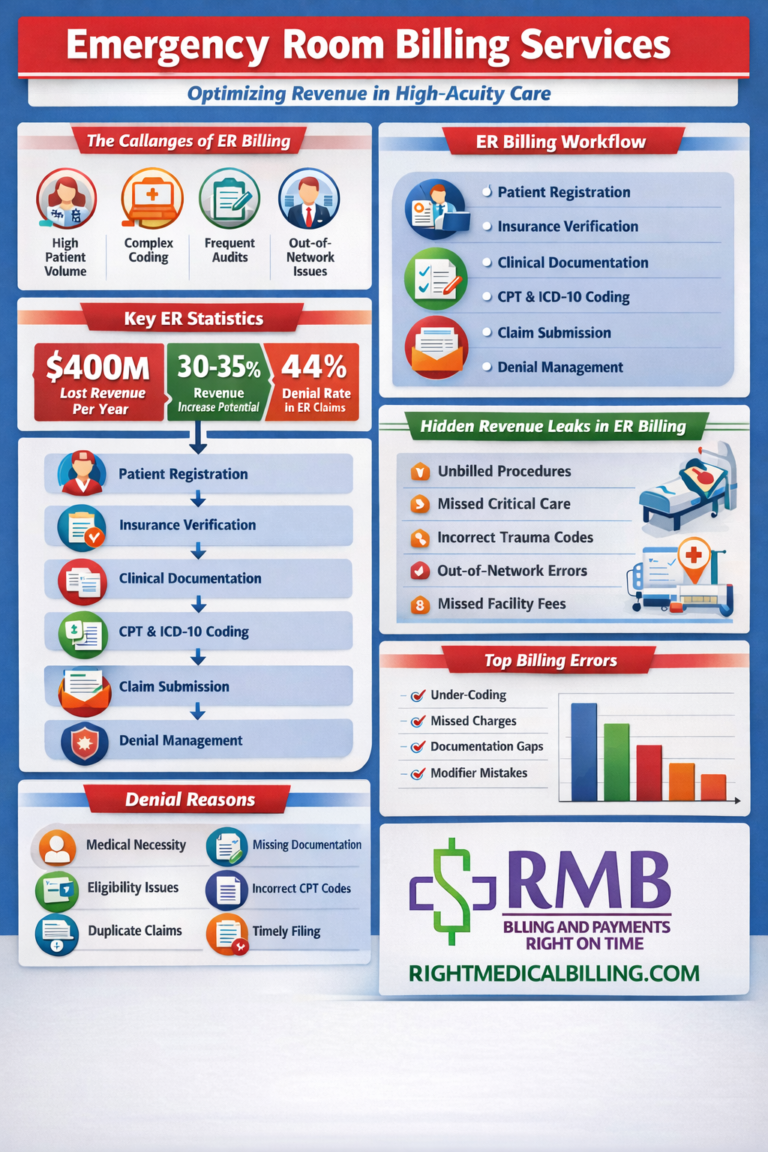
VI. Billing, Coding, & Revenue Cycle Management
Your ER’s financial success hinges on accurate billing, compliant coding, timely claims submission, and rigorous AR (Accounts Receivable) follow-up.
1. Dual Billing Model
Emergency rooms typically bill:
-
Facility Charges: Based on facility fee schedules
-
Professional Services: Physician evaluation and management (E/M) services and procedures
This dual model adds complexity and increases risk of denials without expert billing processes.
2. Coding Complexity
Emergency medicine involves many high-level E/M codes (99281–99285), critical care codes (e.g., 99291), and use of multiple modifiers. Proper use of modifiers like Modifier 25 (same-day significant, separate E/M) or Modifier 59 (distinct procedural service) is crucial for reimbursement. Right Medical Billing
3. Compliance & Payer Rules
Freestanding ERs, especially in Texas, often operate out of network, exposing patients to higher cost sharing. Texas law and federal “No Surprises Act” rules add transparency and balance billing restrictions, requiring clear disclosures about expected costs and network status. Right Medical Billing
4. Claim Denials & AR Management
ER claims are frequently denied due to:
-
Coding errors
-
Lack of medical necessity documentation
-
Missing modifiers
-
Payer policy layers
Without expert revenue cycle management (RCM), ROI suffers dramatically.
VII. Marketing & Patient Access
1. Branding & Positioning
Your ER’s website, local search presence, and community education materials must be clear about:
-
24/7 care availability
-
Emergency services offered
-
Insurance acceptance
-
Billing transparency and patient rights
2. Community Outreach
Partnerships with local EMS, urgent care centers, and primary care providers can improve referral access and appropriate use of services.
VIII. How Right Medical Billing Can Help at Every Step
Starting and operating an emergency room requires specialized billing expertise that most new facilities do not have in-house — and that’s where Right Medical Billing makes a measurable difference.
1. Pre-Launch Billing Consultation
Right Medical Billing works with ER founders before opening to:
-
Advise on the billing and revenue implications of facility structure
-
Set up optimal charge masters and fee schedules
-
Develop compliant workflow processes for capturing charges and encounters
2. Credentialing & Contract Support
Right Medical Billing assists with:
-
Provider and facility credentialing submissions to payers
-
Tracking credentialing progress and follow-ups
-
Ensuring providers are enrolled correctly for Medicare/Medicaid (where applicable)
3. Emergency Department Coding Expertise
ER coding is complex — and improper coding leads to denials and lost revenue. RMB provides:
-
Dedicated coders with emergency medicine experience
-
Audit and quality review to ensure accurate, compliant coding
-
Ongoing education for your clinical and administrative staff
4. Revenue Cycle Management & Denial Prevention
Right Medical Billing:
-
Submits claims with precision and speed
-
Tracks denials promptly and appeals with clinical documentation support
-
Optimizes AR collections and follow-up workflows
5. Compliance & Regulatory Support
RMB helps you:
-
Stay compliant with state and federal billing rules
-
Understand transparency and balance billing requirements (e.g., disclosures in Texas)
-
Navigate surprise billing regulations and payer policies
6. Reporting & Performance Optimization
RMB suites include robust reporting tools to:
-
Monitor performance KPIs
-
Identify high denial trends or underpaid procedures
-
Inform leadership about strategic opportunities
IX. Cost Estimation, Staffing Requirements, and Essential Facilities for an Emergency Room
One of the most critical components of successfully starting and operating an emergency room in Texas or anywhere in the United States is having a realistic understanding of startup costs, ongoing operational expenses, staffing needs, and required facilities. Underestimating these factors can significantly impact cash flow, compliance, and long-term sustainability.
A. Cost Estimation for Setting Up an Emergency Room
The cost of establishing an emergency room varies widely depending on whether it is a hospital-based ER or a freestanding emergency department, geographic location, size, and service scope. Below is a realistic breakdown of typical expenses:
1. Initial Capital Investment
-
Facility Construction or Leasehold Improvements:
$2 million to $6 million+ depending on size, zoning, and local construction costs. -
Medical Equipment & Diagnostic Tools:
$750,000 to $2 million, including imaging, resuscitation equipment, monitors, and lab tools. -
IT Infrastructure & EHR Systems:
$150,000 to $400,000 for EHR, billing software, cybersecurity, and network setup. -
Licensing, Legal, and Consulting Fees:
$75,000 to $200,000 covering state licensure, legal structuring, compliance consulting, and inspections. -
Initial Staffing & Training Costs:
$300,000 to $600,000 (pre-opening hiring, credentialing, and onboarding). -
Marketing & Community Outreach:
$25,000 to $75,000 for branding, website development, and local awareness campaigns.
Estimated Total Startup Cost:
$3.5 million to $8+ million, depending on scale and service depth.
B. Ongoing Operational Costs
Once operational, emergency rooms face significant recurring expenses:
-
Payroll & Benefits: 45–60% of total operating expenses
-
Medical Supplies & Pharmaceuticals
-
Malpractice & Liability Insurance
-
Utilities, IT Support & Maintenance
-
Billing, Coding, and Revenue Cycle Management Services
Without a strong billing and collections strategy, even high patient volumes may not translate into positive margins.
C. Staffing Requirements for an Emergency Room
Staffing is both a regulatory requirement and a patient safety priority. Emergency rooms must maintain adequate staffing 24/7.
1. Clinical Staffing
-
Emergency Medicine Physicians:
Board-certified or board-eligible physicians available at all times. -
Advanced Practice Providers (NPs/PAs):
Support physicians during peak hours and manage lower-acuity cases. -
Registered Nurses (RNs):
ACLS, PALS, and BLS-certified nurses with emergency care experience. -
Radiology & Lab Technicians:
On-site or on-call depending on diagnostic capabilities. -
Paramedics / Emergency Medical Technicians (optional):
Particularly useful for high-acuity or trauma-focused facilities.
2. Administrative & Support Staff
-
Front Desk & Patient Registration Staff
-
Medical Coders & Billers (ER-Specific Expertise Required)
-
Practice Manager / Operations Director
-
Compliance & Quality Assurance Personnel
Staffing ratios must be carefully aligned with expected patient volumes and acuity levels to avoid burnout, delays, and compliance risks.
D. Essential Facilities & Infrastructure
An emergency room must be designed to support efficient patient flow, rapid response, and compliance with safety standards.
1. Core Clinical Areas
-
Triage and patient intake area
-
Fully equipped emergency treatment rooms
-
Resuscitation and trauma bays
-
Nurse stations with direct patient visibility
-
Medication and supply storage areas
-
Isolation rooms (as applicable)
2. Diagnostic & Support Facilities
-
On-site imaging (X-ray, CT depending on scope)
-
Laboratory or point-of-care testing areas
-
Clean and soiled utility rooms
-
Staff break rooms and on-call areas
3. Administrative & IT Facilities
-
Medical records and billing offices
-
Secure server rooms or cloud-based IT infrastructure
-
HIPAA-compliant communication systems
-
Surveillance and security systems
4. Patient Amenities & Accessibility
-
Waiting areas with clear signage
-
ADA-compliant restrooms and entrances
-
Parking and ambulance access
-
Clear billing and patient rights disclosures
E. Financial Sustainability Starts with Billing Strategy
Because emergency rooms rely heavily on complex billing structures, accurate coding, and timely payer reimbursements, financial sustainability begins before the first patient is seen.
This is where Right Medical Billing becomes a critical operational partner.
Right Medical Billing helps ER owners:
-
Build realistic revenue projections
-
Design billing workflows aligned with staffing and facility operations
-
Prevent early-stage revenue leakage
-
Ensure compliance from day one
With years of hands-on experience working with freestanding ERs, urgent care centers, hospitals, and emergency departments, Right Medical Billing understands the financial pressures unique to emergency medicine and helps facilities remain profitable while staying compliant.
Final thought
Launching an emergency room, especially a freestanding ER in Texas or an ER department anywhere in the USA, is a major endeavor — legally, logistically, medically, and financially. Success requires not only compliance with licensing and facility standards, but also a finely tuned revenue cycle strategy to ensure financial sustainability.
With Right Medical Billing as your partner, you gain years of specialized experience working with freestanding ERs, urgent care centers, hospitals, and complex emergency medicine billing scenarios. From pre-launch planning to operational revenue optimization, Right Medical Billing helps ensure your emergency room thrives in today’s competitive healthcare landscape.